
estimated visitors
Project overview · 2 MIN READ
A Music Library That Learns How Tracks Belong Together
MixMan joins ingestion, analysis, curation, listening, and discovery into one musical lifecycle.
From collecting tracks to finding the next one
A music collection becomes more useful when it can help you decide what to play. MixManServer brings ingestion, review, analysis, discovery, and playback into one lifecycle. Music can arrive by upload, SoundCloud link, or YouTube link or search; new material waits in a review queue before joining the trusted library.
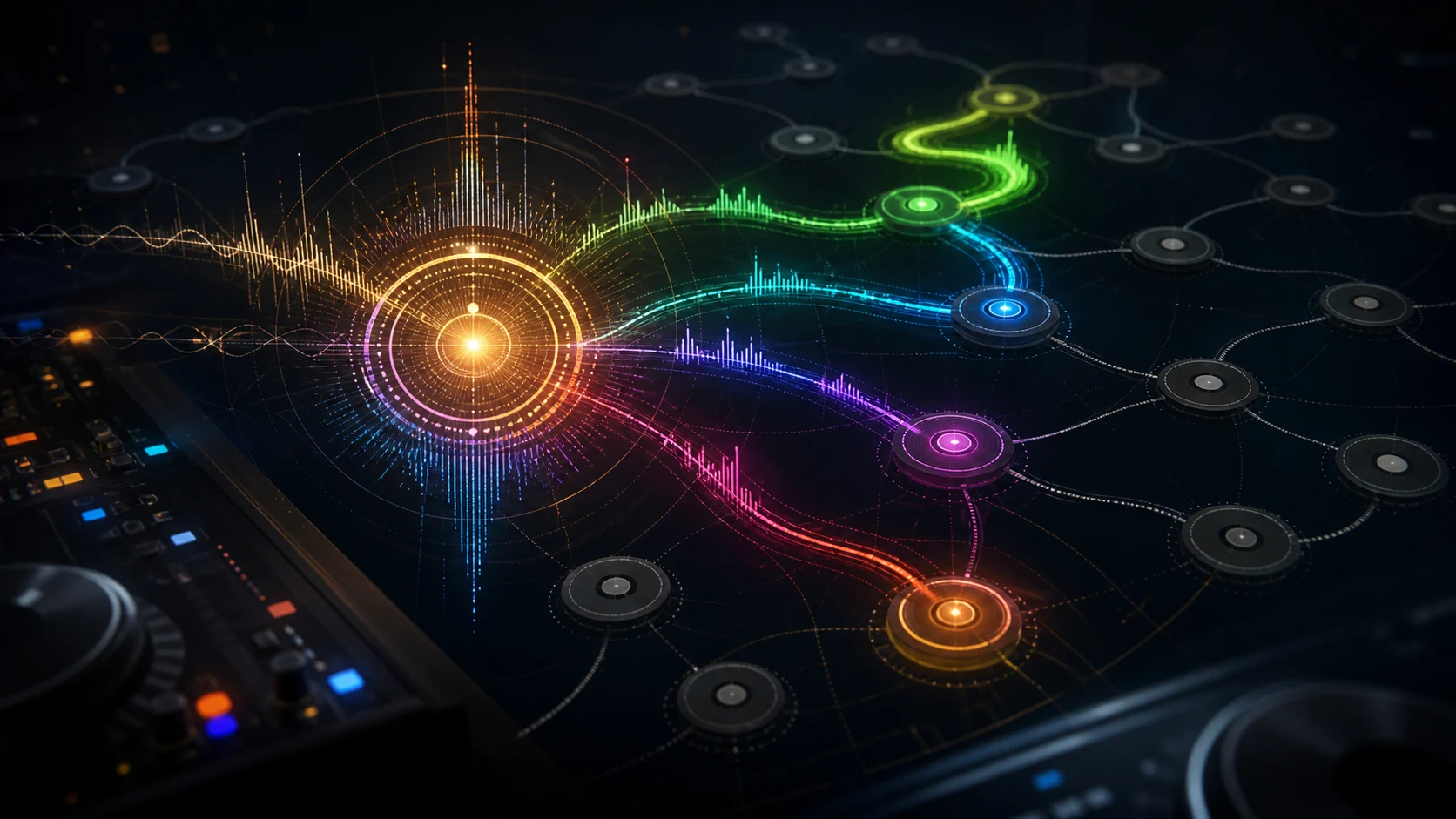
Concept illustration for mixmanserver; not a product screenshot.
Enrich without losing provenance
Once a track arrives, MixMan can enrich it through several complementary sources. Its deterministic Queen Mary analysis extracts BPM, key, energy, quality, similarity features, cue and phrase structure, and possible transition windows. Metadata, MusicBrainz enrichment, semantic descriptions, color, and neural embeddings can add other ways of understanding the same recording. Per-field provenance allows later analysis to coexist with human and administrative edits instead of blindly overwriting them.
The life of a library track
Review separates incoming material from the collection used for listening and discovery. Analysis adds evidence about the music.
flowchart TD
    Source[Upload or source link] --> Review[Review queue]
    Review --> Library[Trusted library]
    Library --> Discover[Search and recommendations]
    Discover --> Player[Listening and queue controls]
From catalog to musical space
The result is more than a searchable catalog. MixMan provides desktop and mobile players, review workflows, track search, a mood-oriented color wheel, recommendations, queue controls, and controlled downloads. Different discovery modes can look at vector proximity, musical heuristics, semantic relationships, color, or agreement among several strategies.
MixMan is ultimately an experiment in turning a private music collection into an explorable musical space. It treats ingestion, analysis, curation, listening, and recommendation as parts of one lifecycle—so the system can explain not only what a track is, but where it might take a listening session next.
PROJECT